Sunday, October 17, 2010

When in Rome

Well here I am! My flight got in around 8:00 a.m. this morning and I booked it to the train station. There were some very nice people on my flight that I had befriended in the Kennedy airport who let me cut in front of them in the custom's line. Then the custom's officer didn't even look at my passport when he stamped it, because he was was too busy telling me that a beautiful girl like me was bound to love Rome!

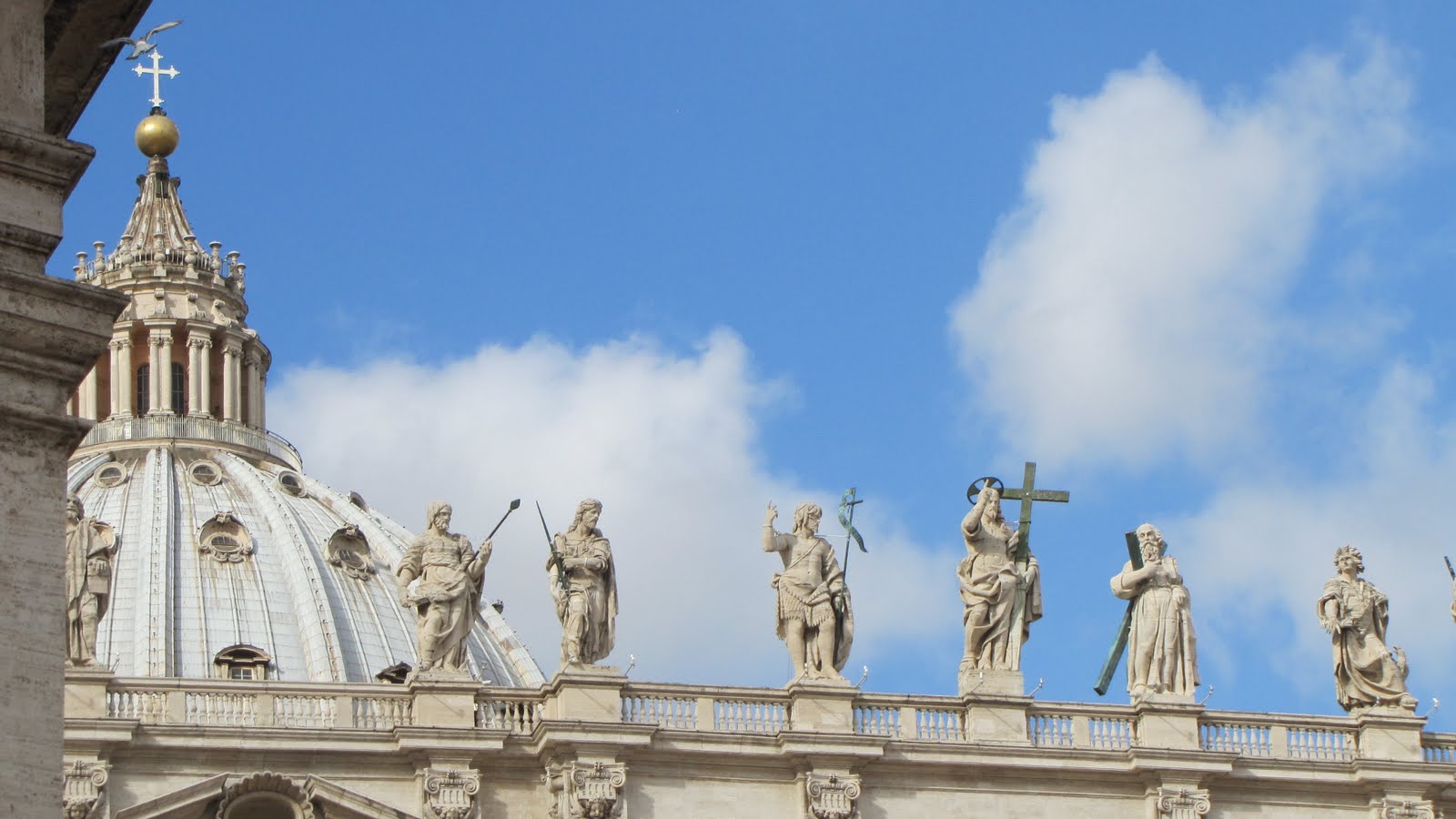
The train from the airport was late... the first train broke down and around 9:30 the train finally got moving. I got to the Travesare station around 9:50 with 10 minutes to spare before the Canonization stated. A quick taxi ride landed me close to St. Peter's square but I wasted another 10 minutes going to the wrong entrance. Finally, 15 minutes late, my water bottle was confiscated and I was finally in St. Peter's square with almost a million people. Since I had not arrive in time to honor my ticket, and therefore have a folding chair to sit in, I stood with the thousands of people filling the square and listened for 2.5 hours as the mass rolled on in Latin, English, Italian, and French.

The mass was beautiful. For what ever reason, when the communities of each of the sainted people ascended the steps of St. Peter's and placed a cross on the alter that was set up outside for all to see, I teared up. Smaller reminder to those of you who don't know, I'm not Roman Catholic. Yet this small act of ritual solidarity to a small group of people who tried to make their world better through their belief in God was touching. The Australian/Scottish saint's people put a wooden cross on the alter... the guy dressed in a kilt placed a set of flowers and then nudged them to the right place with his cane. Even the Vatican can be a place of humor. *smile* We got to see a bunch of nun's and bishop's yawning and checking their watches too. Regardless of all this, the ceremony was beautiful and it was breathtaking to be in St. Peter's square with so many people.

There were TV screens on which to see the pope and the deliberations of the mass. However, after taking a bunch of pictures, I had to remind myself that the experience of being here in Rome was beyond the ability to take pictures. To be present at this ritual, and be present at the physical local of great religious history was in itself an experience to be felt and not so much documented. What I share with you are a few of the pictures that I took, but about an hour into it I put my camera away and sat down on the cobble ground of the square. I closed my eyes and listened to the music of the ceremony, the prayers to God, and the solidarity of the people of the world.

Saturday, October 16, 2010

Raining on Venus


When I was in middle school, my English teacher would often ask us to get out the large heavy literature book that was under our chairs and read from the endless short stories contained within it's tattered cover. While I don't remember many of these stories, one has stuck with me over the years. I have no idea what it was called....

In a time when the other planets of our solar system were colonized, there was a settlement on Venus. This community of people were made up of mainly people who had been born on the planet; the community was a few generations removed from the original colonists from earth. The weather was terrible on Venus. Clouds of sulfuric acid would rain down every day and everyone had to stay inside least they get burned. The sun was never visible because of these storms but since the children never were able to play outside, the lack of sunshine did not bother them.

However, one day a year, it stopped raining for a few hours and everyone stopped what they were doing and danced outside. A few week before this day one year, a group of students discussed what they would do when the rain stopped. Most of the students didn't really care about the few hours they had once a year to play outside. Since they spent their lives inside, some felt that they were forced to endure the elements for those few hours and would rather just stay inside. During these conversations, one quiet boy in the class looked longingly out the windows to the sulfur laden cloud.

For this boy was from Earth. His parents have moved to Venus on a government assignment and this boy missed the sunshine most of all. He missed the green grass and the clean air. He missed a life spent outside; a life with rain he could run around in.

The other students noticed this boy's silence and began to mock him. They called him all sorts of names. They poked and prodded him. On the day that the rain stopped, a few of the students came up with the idea that it would be funny to lock this Earth boy in the closet when the rain stopped. It seemed humorous and ironic that the boy from earth, the one who wanted the rain to stop the most, would be unable to see it; he would be unable to go outside.

When the teacher wasn't looking the students pushed the Earth boy into the closet. The rained stopped and everyone went outside. The rain began again and every one went back inside. No one remembered the Earth boy until the custodian found him later that night. A few weeks later the boy from Earth and his family moved back to Earth and the students on Venus never heard from him again.

***************

Its Friday night, October 16th now that midnight has passed. My flight from Detroit was 2.5 hours late and consequently 10 other passengers and myself missed our flight to Rome. I'm sharing a hotel room with a few other female passengers and we have been booked on a flight tomorrow. I pray that I arrive at the canonization on time for it is the only time in my life I'll get to attend a canonization for someone that I am related to. I really hope that I won't be locked in the closet of a plane, when the rain stops falling in Rome.

Bit about Brother Andre from Wikipedia

File:Frère André 1920.jpg

Alfred Bessette was born in Mont-Saint-Grégoire, Quebec (then Canada East), a small town situated 40 kilometers south-east of Montreal. He was so frail when he was born that the curé baptized on an emergency basis and then conditionally the following day. His was a working class family; his father, Isaac Bessette, was a carpenter and lumberman and his mother, Clothilde Foisy Bessette, saw to the education of her ten children (two others died in infancy). In 1849, with employment scarce and his family living in poverty, Alfred's father decided to move to Farnham (in Quebec) where he hoped to earn a living as a lumberman. Tragically, he lost his life in an accident, crushed by a falling tree, when Alfred was only nine years old. His mother found herself widowed at the age of forty with ten children in her care. She died of tuberculosis within three years, and Alfred found himself orphaned at the age of twelve. He was sent to live with his mother's sister, Rosalie Nadeau, and her husband Timothée, who attempted to establish Alfred in various trades, but the boy's fragile health (which would afflict him throughout his life) made sustained manual labor difficult.

From his earliest days, Alfred exhibited an unusually intense spirituality. He would often spend his scant free time praying before a crucifix or evangelizing his friends, and his many self-imposed penances drew the admiring rebuke of his gentle aunt, who was concerned that the boy was endangering his already poor health.

When he was 20 years old, Alfred joined many Canadians who were emigrating to the United States to work in a textile mill of New England, then operating at full output to supply the needs of the Union army in the American Civil War. Though his health was not robust, he worked doggedly. "Despite my limitations," he said, "There was no one who worked harder than me." When the Canadian Confederation was formed in 1867, he returned to his native country.

Call to devotion

The Pastor of his parish, Fr. André Provençal, noticed the devotion and generosity of the young man. He decided to present Alfred to the Congregation of Holy Cross in Montreal, writing a note to the superior, "I'm sending you a saint." Although he was initially rejected by the order because of frail health, Archbishop Ignace Bourget of Montreal intervened on his behalf, and in 1872, Alfred was accepted, and entered the novitiate of the congregation, receiving the religious name of Brother André, by which he was known for the rest of his life. He made his final vows on February 2, 1874, at the age of 28.

His great confidence in Saint Joseph inspired him to recommend this saint's devotion to all those who were afflicted in various ways. On his many visits to the sick in their homes, he would recommend them in prayer to St. Joseph, and would anoint them lightly with oil from the lamp in the college chapel which always burned before the St. Joseph altar. People claimed that they had been cured through the prayers of the good Brother and Saint Joseph, and they were grateful their prayers had been heard. Brother André steadfastly refused to take any credit for these cures, and, although usually a gentle man, he was known to become enraged at those who suggested that he possessed any healing powers. Because he wanted St. Joseph to be honored, in 1904 Bessette began the campaign to erect a chapel to honor the saint.

Brother André's reputation grew, and soon he was known as the miracle worker of Mount-Royal. He had to face the attacks and the criticism of numerous adversaries.He had the strong support, however, of the diocesan Church, and thousands of cures without apparent medical explanation made him the object of popular acclaim. In 1924 construction of a basilica named Saint Joseph's Oratory, began on the side of the mountain, near Bessette's chapel.